
Before you book
What to expect
Your flowers will change. That is not a fault in the process, it is the process. Real blooms have to give up their water before they can last. I show you that here so you can look forward to the piece as it will be, still your flowers, just in the form that lasts.
What drying does to a flower
Colour shifts
Deep, strongly pigmented flowers usually keep their colour or deepen a little. Pale and pastel blooms tend to soften. White flowers very often go ivory or cream. This is the single biggest surprise for people, which is why colour correction exists.
Texture changes
Petals lose their water and become papery. Some turn slightly translucent in resin, which reads as a lighter patch. It is not mould and it is not damage. It is what a dry petal does with light behind it.
Small marks and bubbles
Resin is poured by hand, so the occasional tiny bubble is normal. Roses often carry faint translucent marks where they were held on the day. I keep both to a minimum rather than pretending they never happen.
Size decides how much fits
A small keepsake cannot hold a whole bouquet. Large blooms may need to be taken apart to sit properly in a smaller shape. If you want full flower heads kept whole, choose a larger piece or tell me before I design.
The condition they arrive in matters most
I preserve flowers as they reach me. I cannot undo wilting, bruising or heat damage from the journey, so posting quickly and packing well changes the result more than anything else I do afterwards. The packing guide walks you through it.
Everything ages, gently
Resin warms to a faint amber over years, a little like late afternoon light. Dried flowers fade slowly. Keeping your piece out of direct sunlight slows both down considerably.
Colour correction
Colour correction is an optional hand-painting step. Once your flowers are dry I work back over them, bloom by bloom, to bring the tone closer to the day.
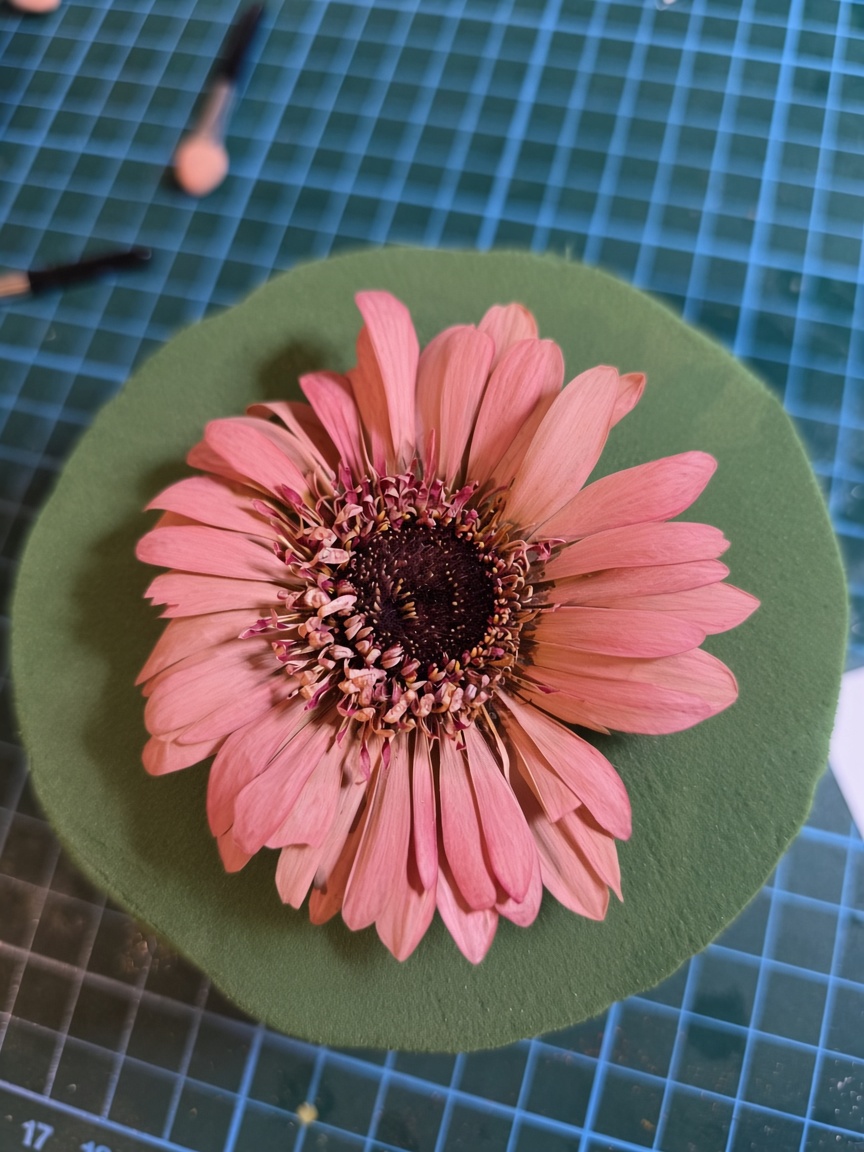 As driedColour corrected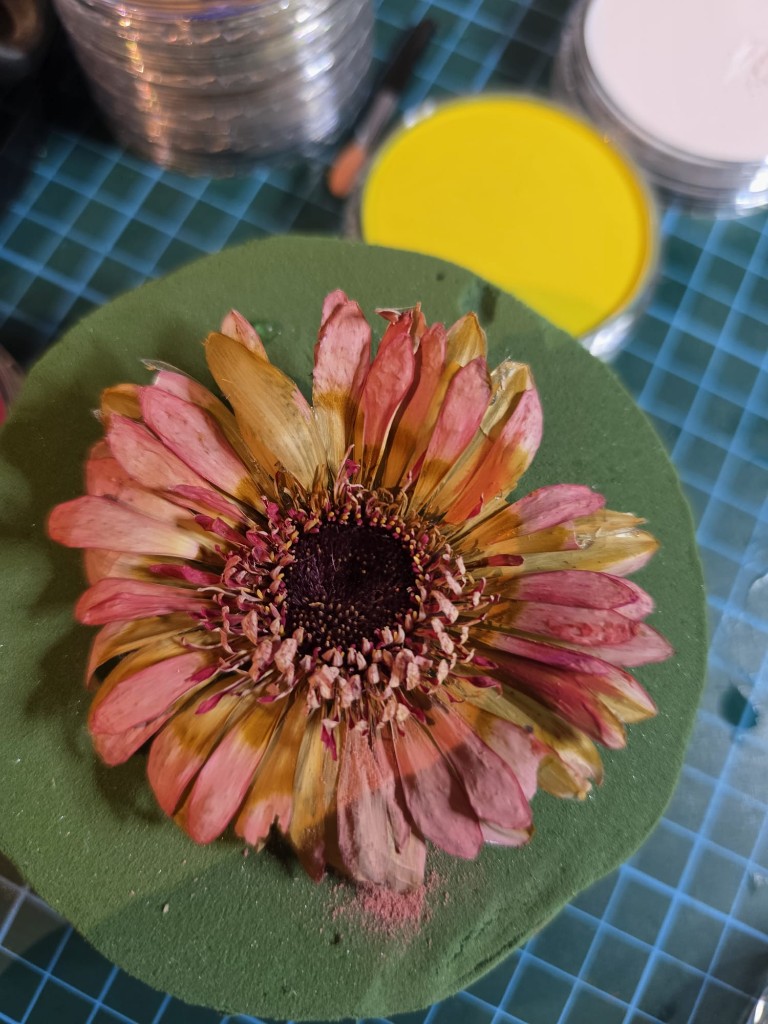
This Gerbera came out of the drying box bleached to ochre and brown along the petal edges, with the pink almost gone. On the right is the same flower after correction, photographed on the same bench.
Correction works best on the freshest flowers. It also works on blooms that were already dried before they reached me, though the result is quieter.
You can add it to any piece when you order. If you are unsure, leave a note with your order and I will tell you what I think once your flowers are dry.
I like to leave a little bit of the original discolouration to prevent the bloom from looking too perfected and fake, whilst still looking beautiful and fresh.
Which flowers need it
A general guide rather than a rule. How a flower dries depends on its variety, how fresh it was when it reached the studio, and what the weather did to it on the way. Send me a photo and I will tell you about your flowers specifically.
Usually keep their own colour
These dry well on their own. I would normally leave them exactly as they are.
- Hydrangea
- Statice
- Sea lavender
- Eryngium (blue thistle)
- Lavender
- Gypsophila
- Wax flower
- Strawflower
- Delphinium and larkspur
- Stock
- Bells of Ireland
- Achillea (yarrow)
- Nigella
- Cornflower
- Craspedia
- Astilbe
- Eucalyptus and most foliage
- Meadow and wildflowers
Often benefit from correction
These are the ones that tend to fade, brown or go ivory. Correction is worth considering.
- Roses, especially white, cream and blush
- Garden roses
- Peonies
- Anything white or ivory
- Orchids
- Anemones
- Pale ranunculus
- Calla lilies and lilies
- Chrysanthemums
- Dahlias
- Gerbera
- Tulips
- Sweet peas
- Lisianthus
- Protea and tropical blooms
I do not colour correct these
Too fine to paint without breaking the heads, and they hold their colour well anyway.
- Gypsophila
- Sea lavender
- Wax flower
- Strawflower
- Blue thistle
- Chamomile
- Forget-me-not
- Rice flower
- Amaranthus
- Fine seed heads and grasses
Why it takes as long as it does
I am booking for 2027. Drying alone takes weeks, and it cannot be hurried without trapping moisture, which ruins a piece months later. After that comes design, the pour, curing, and finishing, each one done by hand, one piece at a time.
I am one maker, not a production line. That is the reason for the wait, and it is also the reason your flowers are handled by the same person from the day they arrive to the day they go home.
Looking after your piece
- Keep it out of direct sunlight and away from radiators and damp rooms.
- Dust with a soft dry cloth. No cleaning sprays or solvents on resin.
- Resin pieces are heavy. Keep larger ones low and out of reach of small hands.
- A little ambering over the years is normal, and not a fault.
If anything here worries you, ask me before you book. I would rather talk you out of the wrong piece than take money for it.